When Score Scales Shift: Understanding the DET–TOEFL Relationship 🎯
What happens when a major English test changes its score scale overnight? Confusion. Emails. Policy meetings.
But before rewriting your requirements, pause.
Concordance studies exist for one reason: clarity. When two exams measure the same construct—academic English proficiency—institutions need a reliable way to compare scores. If you require a TOEFL 90, what DET score reflects the same level? Concordance research provides that bridge so policies stay consistent and defensible.
When reporting formats shift, the real question isn’t “Did the numbers change?” It’s “Did the meaning change?” Understanding how score scales map to each other prevents unnecessary revisions.
In this post, we will:
- Revisit what the DET–TOEFL concordance represents
- Explain what TOEFL’s new reporting scale means for score interpretation
- Highlight related resources, including the DET–IELTS concordance and CEFR alignment
Top 5 Universities Accepting the Duolingo English Test 🌍
How DET Scores Relate to TOEFL Scores
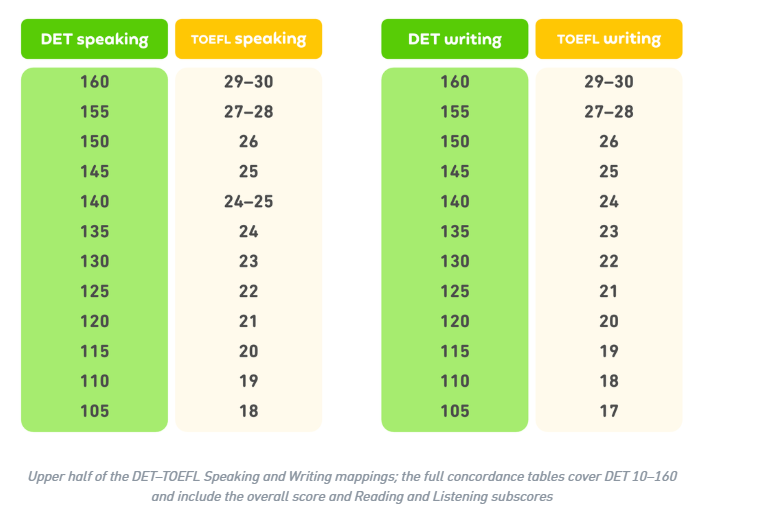
The DET–TOEFL concordance was built using data from test takers who completed both exams within a three-month window. By examining paired score reports, researchers identified strong statistical relationships between the two assessments. Despite differences in format, delivery, and design, the exams measure closely related constructs of academic English proficiency. This evidence of concurrent validity forms the foundation of the concordance tables available on our Scores page.
Below is a view of the upper portion of the DET–TOEFL Speaking and Writing mappings. The complete concordance tables span DET scores from 10–160 and include overall scores as well as Reading and Listening subscores.
What About TOEFL’s New 1–6 Scale? 🔄
When TOEFL announced a new 1–6 reporting scale in early 2026, it immediately raised questions. Would concordance tables need to change? Would DET requirements need adjustment? The short answer: not right now.
The existing DET–TOEFL concordance remains the recommended reference. It is based on TOEFL iBT total scores reported on the 0–120 scale—and importantly, ETS will continue reporting those 0–120 scores alongside the new 1–6 scale for a two-year transition period. That dual reporting signals intended comparability between the updated TOEFL and the previous version.
In practical terms, institutions can continue using the published concordance to map DET scores to TOEFL 0–120 totals (and subscores), then apply ETS guidance to interpret how those totals correspond to the new 1–6 categories. As always, we will continue monitoring DET–TOEFL score relationships and will update concordance guidance if new evidence indicates that a revision is warranted.
 Lance Graney
Implications for Institutional Score Requirements
If your institution accepts both the DET and TOEFL and is revisiting policies because of TOEFL’s new reporting scale, there is no need to adjust DET minimum scores solely due to that change. The meaning of DET scores remains the same. The scale is stable, and its interpretation continues to be supported by existing research.
For institutions that want to interpret DET scores alongside TOEFL’s new 1–6 categories, the process is straightforward: use the published DET–TOEFL concordance to map DET scores to TOEFL 0–120 totals (or 0–30 subscores), then apply ETS guidance to understand how those totals translate into the new reporting scale. CEFR alignment and other DET research resources can further support internal policy review. In essence, while TOEFL’s reporting format has evolved, the DET’s scale and score meaning have not.
DET–IELTS Concordance and CEFR Alignment 🌍
For institutions reviewing language requirements more comprehensively, it can be valuable to look beyond a single test comparison. The DET provides two additional research-based tools that help ensure score policies remain consistent and defensible across multiple assessments.
The DET–IELTS concordance study examined 3,586 official score reports and applied established equating methods to map DET scores onto the IELTS Academic 1–9 band scale. This includes both overall scores and Individual Subscores, offering a detailed view of how performance aligns across the two exams.
How to Send Your Duolingo English Test Results to Institutions
Additionally, an independent CEFR alignment study—conducted by applied linguistics experts—linked DET scores to the Common European Framework of Reference. Because CEFR is widely used as an international proficiency benchmark, this alignment supports institutions that rely on CEFR standards for admissions or regulatory decisions.
Ongoing Support and Research Commitment 📘
Duolingo will continue collecting data on DET–TOEFL score relationships and will remain transparent about research methods in any future concordance updates. Concordance tables are practical tools, but they are most effective when considered alongside CEFR alignment, predictive validity evidence, and institutional outcome data. While TOEFL’s new reporting scale does not require changes to DET score requirements, periodic review of minimum thresholds remains a sound institutional practice.
The essential message is straightforward: TOEFL’s new 1–6 scale does not alter the meaning of DET scores. The current DET–TOEFL concordance, DET–IELTS concordance, and CEFR alignment remain evidence-based resources for setting and reviewing English proficiency requirements across tests. As additional post-change data becomes available, further research will be conducted and shared with clear, institution-focused guidance.