🎤 How to Score 130–140 on the Duolingo English Test Interactive Speaking Section (2026 Guide)

The new Interactive Speaking questions on the Duolingo English Test are making many students nervous, and honestly, that makes sense. A lot of test takers think they need perfect English, advanced vocabulary, or memorized “smart sounding” answers, but that often makes responses sound robotic.
In reality, the Interactive Speaking section is testing something much simpler: can you respond naturally, continue speaking smoothly, and organize ideas quickly under pressure? Remember, you only have about 20–30 seconds to answer, so this is not an academic presentation. Students scoring in the 130–140 range are usually doing three things well: starting immediately, giving one clear idea plus one detail, and sounding natural and conversational.
15 Helpful Phrases for Describing Photos on the Duolingo English Test
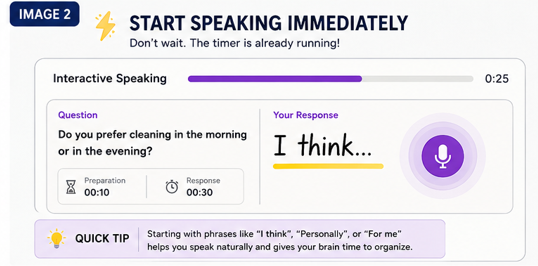
⚡ Strategy #1: Start Speaking Immediately
One of the biggest mistakes students make is waiting too long before answering.
You can almost see the panic happening:
- staring at the screen
- thinking too hard
- trying to create the “perfect” answer
Meanwhile…
⏱ the timer is already moving.
Instead, start naturally with:
- “I think…”
- “Personally…”
- “For me…”
These phrases help your fluency immediately.
Even better:
they give your brain an extra second to organize the rest of the answer while still sounding natural.
✅ High-Scoring Example
Question:
Do you prefer cleaning in the morning or in the evening?
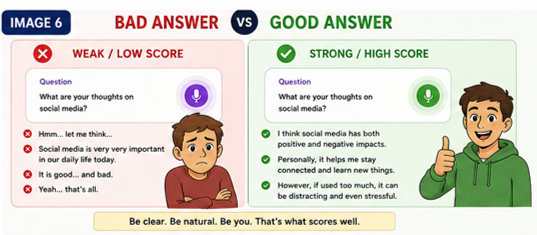
Strong Answer:
“I think I prefer cleaning in the evening. Personally, after a long day, it feels like a nice way to wind down. For me, tidying up in the evening helps me start the next morning fresh.”
Notice something important here:
✅ The answer starts immediately
✅ The response sounds conversational
✅ The grammar is strong without sounding unnatural
The student is not trying to sound like a university professor.
They simply sound comfortable speaking English.
That’s what fluency sounds like.
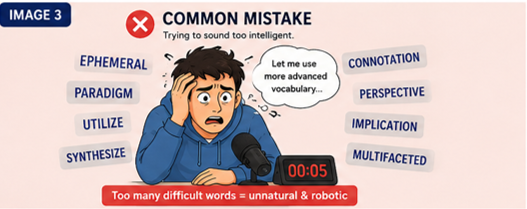
🚫 Common Mistake: Trying to Sound Too Intelligent
🚫 Some students believe:
“More complicated vocabulary = higher score.”
But that’s not necessarily true.
Sometimes students use so many difficult words that their answers become awkward, unnatural, and difficult to follow. And honestly, it can sound like somebody swallowed a dictionary five minutes before the exam. 🤖📚
Instead, focus on:
- 🎧 natural flow
- 🧠 clear organization
- ✨ smooth complex sentences
That matters much more than trying to sound overly academic.
🧠 Strategy #2: One Idea + One Detail
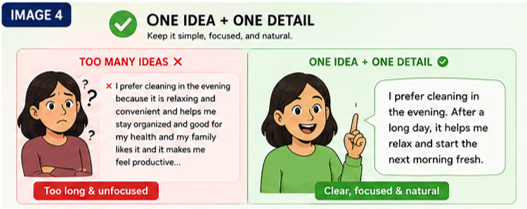
A very common mistake in Interactive Speaking is trying to say too much.
Remember:
you only have around 20–30 seconds.
You do NOT need:
- five examples
- a giant explanation
- an academic speech
Instead, use this structure:
✅ Answer the question
✅ Add one reason, example, or experience
That’s enough.
Simple answers often sound more fluent.
🎤 Example
Question:
How often do you usually clean your room?
Strong Answer:
“For me, I try to clean thoroughly about once a week. I think having a weekly routine helps keep things under control, and it prevents the room from becoming too messy.”
Notice:
- one clear idea
- one supporting detail
- organized structure
Very natural.
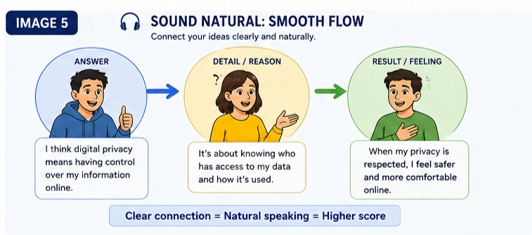
🎧 Strategy #3: Sound Natural
The Interactive Speaking section is designed to feel conversational.
That means the DET wants to hear:
- smooth rhythm
- confidence
- connected ideas
- natural pacing
You do NOT need:
- perfect grammar
- impossible vocabulary
- memorized scripts
Actually, memorized templates can sometimes sound robotic.
Instead:
focus on sounding relaxed and human.
✅ Natural-Sounding Complex Sentences
Good DET answers often include:
- connected thoughts
- explanations
- cause-and-effect ideas
For example:
“Personally, I prefer studying in the morning because I feel much more focused at that time of day.”
That sentence is:
- grammatically complex
- natural
- easy to understand
That is MUCH better than forcing difficult vocabulary unnaturally.
5 Tips for the Read Then Speak Question: Duolingo English Test
🎤 Full Interactive Speaking Example
Question:
What does digital privacy mean to you?
Strong Answer:
“I think digital privacy means having control over my personal information online. Personally, it’s about knowing who has access to my data and how it’s used. For me, when my privacy is respected, I feel safer and more comfortable online.”
Question:
What are your thoughts on targeted advertisements?
Strong Answer:
“I think targeted ads can be both useful and intrusive. Personally, I sometimes appreciate seeing products that match my interests, but if advertisements rely too heavily on private information, they can feel invasive.”
Question:
Why do some people procrastinate?
Strong Answer:
“I think people procrastinate because they feel overwhelmed or distracted. Personally, if a task seems too large or stressful, it becomes easier to avoid it temporarily rather than starting immediately.”
🚫 Biggest Interactive Speaking Mistakes
Here are some of the biggest reasons students lose points:
- ❌ Waiting too long before speaking
Silence hurts fluency. - ❌ Trying to memorize everything
Memorized answers sound unnatural. - ❌ Using vocabulary that feels forced
Simple, fluent English is stronger. - ❌ Speaking too quickly
Rushing often reduces clarity. - ❌ Trying to include too many ideas
Keep answers focused and organized.
❓ FAQ — Duolingo English Test Interactive Speaking
How long should DET Interactive Speaking answers be?
Most answers are around 20–30 seconds long. You should answer directly and continue naturally without rushing.
Do I need advanced vocabulary for a 130+ score?
No. Natural fluency and strong sentence structure are usually much more important than difficult vocabulary.
Is it okay to say “I think” during Interactive Speaking?
Yes. In fact, phrases like “I think” and “personally” often sound natural and help you begin speaking immediately.
What is the biggest mistake students make?
Trying too hard to sound intelligent. Many students become robotic because they focus too much on difficult vocabulary instead of natural fluency.
Should I memorize templates?
No. Small opening phrases are okay, but fully memorized answers often sound unnatural.